
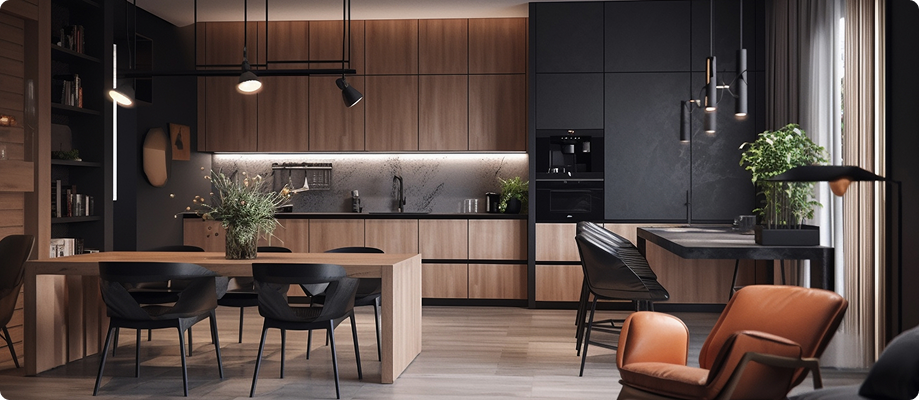
One of the biggest decisions you'll make when renovating or building isn't structural at all, it's deciding what you want the finished home to feel like. Get it right and you'll walk in every day and love it. Get it wrong, or chase a trend that dates fast, and you can find yourself wanting to redo a room within a few years. So before you pick a single tile or paint colour, it's worth understanding where Australian home design has actually moved in 2026, and, just as importantly, which trends are worth committing to and which are best kept to the things you can easily change later.
Here's our honest read on the year, drawn from what we're seeing in real homes and across the wider industry.
Warmth is in; stark minimalism is out
The single biggest shift over the past few years has been away from cold, clinical spaces and toward warmth, texture and natural beauty. The hard, all-white interior and the cool blue-grey palette that dominated from roughly 2015 to 2020 now look distinctly of their era. In their place: warmer, richer neutrals, warm taupe, creamy off-whites, soft "greige" (the grey-beige blend that's become the default neutral), and grounded earthy tones like deep olive, warm walnut and muted terracotta.
These palettes do something the cool-grey era never quite managed, they make a room feel calm and inviting rather than sterile. They also age far more gracefully, which matters when you're spending real money on a renovation you want to love for a decade or more.
Natural, authentic, tactile materials
Alongside the warmer colours, 2026 is defined by materials that feel real. Natural stone and convincing stone-look surfaces with bold veining, genuine timber, handmade-look tiles, microcement and lime-wash finishes are all having their moment. The common thread is texture and authenticity, surfaces you want to run your hand across.
The standout detail is fluting and reeding: vertical ridged textures showing up on cabinetry, joinery, glass and feature walls. Used well, fluting adds depth and a custom, designer feel without adding clutter, which is exactly why it's everywhere right now.
"Conscious longevity", building to last
One of the most significant trends isn't a look at all; it's a mindset. With property prices high and the cost of moving steep (stamp duty alone is "dead money" to many homeowners), more Australians are choosing to invest in the home they already have rather than upgrade and move. That's changed how people spend on renovations.
The trend the industry calls "conscious longevity" means choosing durable, climate-resilient materials designed to last twenty years, rather than quick-flip finishes chosen only to photograph well and sell fast. It means spending a little more up front on the things that are hard to change, quality joinery, good flooring, proper waterproofing, and trusting that it saves money and stress down the line. We've always built this way, so it's good to see the wider market catching up.
Curves, softness and quieter forms
Hard, square edges are giving way to softened, curved forms, rounded vanities, arched nooks and doorways, gently curved island benches, and furniture with organic lines. The effect is a space that feels more relaxed and less rigid. You don't need to curve everything; even one arched detail or a rounded island can take the hard edge off an otherwise linear room.
Indoor–outdoor living, the Queensland way
This one is practically made for the local climate. The line between inside and outside keeps blurring: bi-fold and stacker doors that open a living room right up to the deck, the same flooring flowing seamlessly from inside to out, and verandahs and patios treated as proper "outdoor rooms" rather than leftover space. In Brisbane especially, designing for this connection is one of the highest-value things you can do, because it effectively extends your living space for much of the year.
The "jewel box" room
Finally, a fun one. Small, contained spaces, powder rooms, ensuites, studies, butler's pantries, have become the place where people experiment with bold, saturated colour, dramatic wallpaper, moody paint and statement hardware. The logic is sound: a small room is a low-risk, lower-cost canvas, so you can be adventurous somewhere it won't overwhelm the whole home or break the budget. A richly coloured powder room is one of the most memorable things a guest encounters in a house.
Our advice: timeless bones, trend-led extras
If there's one principle worth taking from all of this, it's this: put your money and your caution into the things you can't easily change, the layout, the quality of the build, the flooring, the joinery, the waterproofing, and keep them timeless. Save the trend-led choices for the elements you can swap out later: paint, tapware, mirrors, accessories, a feature tile in a small zone. That way your home feels current today and still looks considered in ten years, without locking you into an expensive redo when fashions move on.
If you'd like help translating any of these ideas into a plan for your own home, that's exactly what our design process is built for. Talk to us about your project, we'd love to hear what you're picturing.